Digital Story Package

What is activism?

     According to MasterClass, activism is defined as the practice of creating awareness, pushing for change, and/or giving support for a cause, political movement, organization, or belief. While many individuals envision people marching in streets with signs when they hear the word “activism” or “protest,” activism, in reality, can be manifested in nearly all aspects of life, including day-to-day situations. Whether it be uplifting a colleague’s voice in a meeting whose contributions are often dismissed, or organizing a sit-in at the local capital, the world of activism is multifaceted and is something everyone is capable of participating in to leave a space better than how they entered it.

High Impact Activist

WHY activism matters

      For centuries, activism has been the force behind many revolutions and movements that have shaped, and are still shaping, the world we live in today. Numerous policy changes, laws passed/blocked, culture shifts, etc. have been a result of revolutions and movements such as Nat Turner’s Rebellion, the Women’s Suffrage Movement, the Boston Tea Party, the Civil Rights Movement, the list goes on. Without people uniting to advocate for progression and equity in their communities/society as a whole, individuals wouldn’t have the same liberties they have today. 

    Joyce Evans, an activist, and educator, is a living testament to the power of activism and unity. Her activism journey started during her college career at Bennett College when she helped lead the desegregation of the S&W Cafeteria, a Southern-style restaurant, in Greensboro North Carolina during the Sit-in Movement. The Sit-in Movement emerged in the wake of the Civil Rights Movement during the early 1960s. The movement began in a 50-cent store in Greensboro, North Carolina by four A&T University men who agitated for racial desegregation, then quickly spread across the South as more people joined in on the demonstrations. The contributions of Joyce and other participants in the Civil Rights Movement challenged the status quo and helped put an end to the Jim Crow system.  *Click on Icon Below for Joyce Evans’ Full Testamate *

     While society has come far as a whole, there is always room for improvement. This is why activism will always remain relevant and why each individual contributing to a collective effort to make a difference is vital for creating a better world for people today and for generations to come.

Activism in the digital age

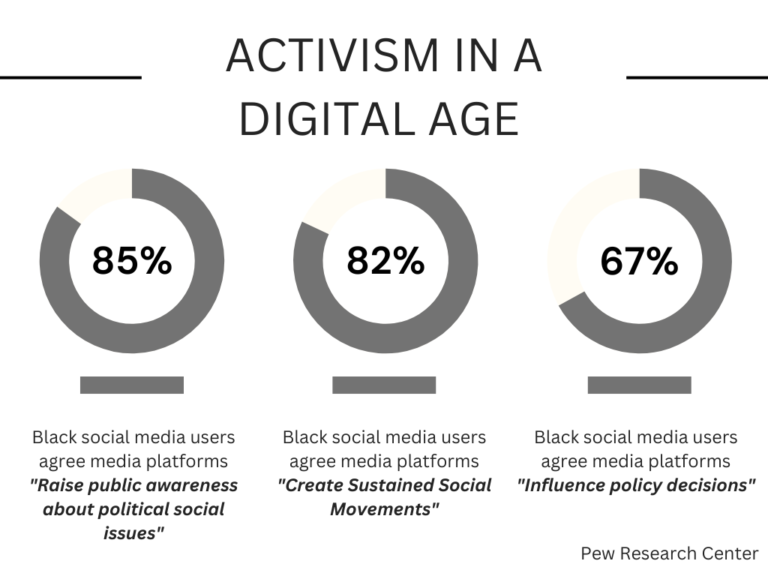
  Since the invention of the Internet in the 1980s, the use and innovation of technology have skyrocketed and show no signs of slowing down anytime soon. The innovation of technology led to the rise of social media which has influenced today’s culture in the way people socialize, communicate, and overall live their everyday life. In addition to everyday life, social media has also opened a new channel for activism.

digital Age in 2023

People Use Mobile Phones (68% of World Population) Source-DataRePortal
0 Bil
People are Internet Users (64.4% of World Population)
0 Bil
People are Social Media Users (Nealry 60% of World Population)
0 Bil


  Like anything, it is important to use social media with intention when it comes to activism to avoid falling into “slacktivism,” endorsing and promoting political/social causes and movements online but with little personal effort that is relatively ineffective. A common example of slacktivism is the black square trend on social media during 2020 in relation to the Black Lives Matter Movement, or a less specific example is online petitions. While these efforts are great for raising awareness, they should not be mistaken as a means to an end. Instead, social media has the potential to act as a launching board for initiatives, as media platforms make connecting with individuals, raising awareness, spreading resources, marketing, etc. much easier to do, which is a major advantage to activism work.

Activism need-to-knows

    When doing activism work there are a few important things to remember to ensure you are helping people, but not at the sacrifice of your health and well-being. 

ff 

1. Know the “Why” and Prioritize Balance

   When doing activism work you are prone to face challenges and disappointments which can be draining. There might even be moments when you feel as if your efforts are getting anywhere and you should give up. In moments like these, individuals are reminded of the importance of knowing their “why” (Know “why” you are doing the work) and of the purpose to act as a reminder when needed. Plus, having a good support system along with pouring into other passions not related to activism is crucial to keep momentum in your initiatives while also keeping your sanity.

2.You are Not a Super Hero

   Never underestimate the power an individual holds to make an impact. Greta Thunberg began one of the largest environmental movements with just herself and a sign. Many people are under the false assumption that they have to take action on every single cause that they are presented with. Of course, to effectively do this is impossible, which can lead people to feel overwhelmed and even guilty for not actively participating/contributing to the cause. It is best practice to choose a cause or two that significantly resonates with you to then invest your time in effort into it. This approach is far more efficient and practical than burning yourself out trying to tackle all the incongruities of the world. 

   Side Note: Supporting other activists working on other various causes is a great way to show your support for initiatives you’re not heavily involved in. This may look like connecting an activist with resources or people in your network or contributing a number of funds to a non-profit.

3. Channel Your Talents and Strengths 

     Everyone offers a set of skills and strengths that can add great value to a team effort. The same is the same for activism. Identify your strengths (Ex. maybe it’s instantly connecting with people you’ve never met before or you’re very detail-oriented), passions, and skills, and then implement them into your activism work! For instance, some artists chose to focus their work on illustrating stories or issues within their community. Again, activism is multifaceted. There is no limit. 

    *** Side Note: Need help identifying some of your strengths that can potentially aid in your activism journey? Well, look no further and take the activism identifier quiz below!

 

Sources

https://www.masterclass.com/articles/activism

https://www.womenshistory.org/resources/general/short-history-activism

https://datareportal.com/reports/digital-2023-global-overview-report